Protecting Children in Armed Conflict by Shaheed Fatima
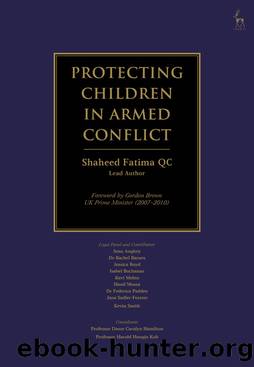
Author:Shaheed Fatima [Fatima, Shaheed]
Language: eng
Format: epub
Tags: Political Science, Human Rights
ISBN: 9781509923045
Google: cahvDwAAQBAJ
Goodreads: 42170978
Publisher: Hart Publishing
Published: 2018-09-01T00:00:00+00:00
2.Problems and Deficiencies in the Legal Framework
5.57As we noted at the outset of this Chapter, the IHL and ICL legal regimes for protection of children from rape and other forms of sexual violence in conflict are comprehensive and well-developed when viewed as a whole. Thus, there is no doubt that rape and other forms of sexual violence (of sufficient seriousness): (i) constitute violations of IHL in both IAC and NIAC; (ii) constitute war crimes (in both IAC and NIAC) and crimes against humanity and may, in principle, constitute genocide; and (iii) that children of both sexes are encompassed in these protections.
5.58We note that in IAC rape and other forms of sexual violence are not expressly identified as grave breaches of the Geneva Conventions. However, this has not created a gap in protection for the following reasons:
5.58.1First, this has not created a gap in substantive protection. This is because, as noted at paragraph 5.27, above, sexual violence in IAC can amount to âtorture or inhuman treatmentâ, âwilfully causing great sufferingâ or âcausing serious injury to body or healthâ, each of which is itself a grave breach of the Geneva Conventions.111 The ICRC commentary on CIL Rule 156112 states that rape âwould have to be considered a grave breachâ on this basis.113 There are examples of cases where rape has been prosecuted under the grave breaches provisions.114 Furthermore, there is increasing support internationally for acknowledgment that sexual violence per se should be regarded as a grave breach of the Geneva Conventions. For example: (i) the delegates to the International Conference for the Protection of War Victims held in Geneva in 1993 declared that âacts of sexual violence directed notably against women and children ⦠constitute grave breaches of international humanitarian lawâ;115 and (ii) two thirds of UN Member States endorsed the UNGA declaration on âCommitment to End Sexual Violence in Conflictâ, adopted in 2013, pursuant to which states recalled âthat rape and other forms of serious sexual violence in armed conflict are war crimes and also constituted grave breaches of the Geneva Conventions and their first Protocolâ.116 In any event, there is no gap in substantive protection because, as set out in detail above, rape and other forms of sexual violence across a whole spectrum of gravity are expressly recognised as war crimes and crimes against humanity in the Rome Statute.
5.58.2Second, this has not created a gap in the structure of accountability (though in practice, it is highly challenging to secure convictions). The classification of offences as a âgrave breachâ of the Geneva Conventions is important because it affects a stateâs legal obligations. For example, under Articles 146â47, GCIV, as extended by Articles 85â86, API, states have obligations to prosecute or extradite perpetrators of grave breaches of the Geneva Conventions. These obligations do not arise in the case of war crimes that are not grave breaches. However, ICRC, CIL Rules 157â58 and the associated commentary suggests that, as a matter of CIL, states must investigate war crimes (including rape) and, if appropriate, prosecute suspects.
Download
This site does not store any files on its server. We only index and link to content provided by other sites. Please contact the content providers to delete copyright contents if any and email us, we'll remove relevant links or contents immediately.
| Anthropology | Archaeology |
| Philosophy | Politics & Government |
| Social Sciences | Sociology |
| Women's Studies |
The Secret History by Donna Tartt(19085)
The Social Justice Warrior Handbook by Lisa De Pasquale(12190)
Thirteen Reasons Why by Jay Asher(8909)
This Is How You Lose Her by Junot Diaz(6885)
Weapons of Math Destruction by Cathy O'Neil(6279)
Zero to One by Peter Thiel(5801)
Beartown by Fredrik Backman(5751)
The Myth of the Strong Leader by Archie Brown(5507)
The Fire Next Time by James Baldwin(5442)
How Democracies Die by Steven Levitsky & Daniel Ziblatt(5218)
Promise Me, Dad by Joe Biden(5153)
Stone's Rules by Roger Stone(5087)
A Higher Loyalty: Truth, Lies, and Leadership by James Comey(4960)
100 Deadly Skills by Clint Emerson(4924)
Rise and Kill First by Ronen Bergman(4788)
Secrecy World by Jake Bernstein(4752)
The David Icke Guide to the Global Conspiracy (and how to end it) by David Icke(4717)
The Farm by Tom Rob Smith(4507)
The Doomsday Machine by Daniel Ellsberg(4490)
